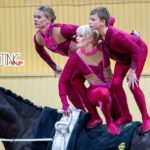
Back to Sweden! After fourteen years – and with two years of delay due to the pandemic – the highest championships of equestrian vaulting return to the northern lands of Sweden. This year, the Senior European Championships were joined by the Junior World Championships and, for the first time, the World Championships for Young Vaulters. Vaulters from all over the world gathered in a sweet Flyinge with golden fields, now illuminated by the grazing sun, now bathed by some light drizzle. The competitions were held from 24 to 30 July at the Flyinge Kungsgård, a monumental and magnificent complex of stables, founded in 1661 by King Charles X Gustav, the oldest riding stable still in operation.
A rich program, six days of intense competitions with old and new protagonists well managed by the Swedish organization. Perhaps the only defect, apart from a race field maybe a little tight, the presence of a large screen in the test field that has often very disturbed the horses, so much so that on several occasions the longeurs were forced to enter the test field covering the eyes of the horse to prevent him to see the swirling of bright images on the screen. Otherwise everything was perfect.

As usual it was nice to find the “old friends” among the supporters, with their comforting, old, stainless customs. So here is the stadium cheer of the Germans, always numerous, with their back and forth before each entry. Here is the voice of the bearded Danish gentleman who incites his countrymen (I do not know what he says, but his words in the silence that precedes the beginning of the music are a must!), here is the “siren” of the Dutch, or the inevitable “hop Suisse”…
They were an exciting Worlds and Europeans, not obvious, full of twists and turns, which have seen more than once predictions and rankings overturn as the competitions progress.
The Junior and Young Vaulters World Championships
 In the men’s field prediction was almost taken for granted, Sam Dos Santos (NED, R. Pierik, Chameur) won easily, even if his performances in free practice were not among his best. Already far ahead after the mandatory, with the first free further increased the distances, while with the second he was content to confirm the position. His level is objectively well above that of others, so much so that one might wonder why he participated in the junior category and not in young vaulter. The real surprise (to be followed very carefully in the coming years) was however Lukas Heitman (GER, A. Wiemann, Curt) silver medal. Despite his young age, Heitman performed a complex freestyle, played with confidence and with an unusual interpretive ability, which allowed the public to try a very strong transport. Both Heitman’s and Dos Santos’ freestyles were rated with similar scores.
In third place was the French Baptist Terrier (S. Langlois, Ultrachic), which confirms how flourishing and rich in young talents is also the transalpine vaulting, besides the German one.

The Women’s Junior Championship was anomalous in many ways. After the compulsories, specialties in which they traditionally excel, German athletes have found themselves unusually in pursuit of many opponents. On the contrary, in the free practice they did a little more by gaining several positions, but without being able to reach the podium. The first step unexpectedly went to the Austrian Clara Ludwiczek (K. Haidacher, Domino), who, from the sixth position at the end of the first round, rose in the standings to the top thanks to a very clean free exercise, but also to a bit of luck. The French Oceane Gehan (M. Dupon Joosten, Barrington), who really stunned everyone with her initial freestyle, was in fact in the lead after the first round.  Will she be the new Manon Moutinho? The young French vaulter was already well positioned in the standings after the compulsories, but she literally outclassed every other competitor with her first freestyle. A beautiful exercise, masterfully performed. Oceane was fluid, very light, with a surprising interpretation of the music. Unfortunately in the decisive test she was betrayed by her horse, which prevented her from performing the first part of her exercise worthily. Although she then recovered, confirming her exceptional talent, the score was quite low, catapulting her to fourth place in the final standings. So is vaulting, even in the individual competition you are actually participating in the team!
Exceptional also the Danish Josephine Vedel Sondergaard Nielsen (H. Haagen Hansen, Tophoejs Geleto Lieto), who earned the silver medal. Always in second position throughout the race, she was mocked for gold for a handful of thousandths. She was also extremely clean in her movements, with a commendable interpretation of the music and with original and very complex figures. For many the moral winner of the title.
Bronze to Giorgia Varisco (ITA, L. Carnabuci, Rosenstolz 99), whose technical level has been growing more and more and who has brought back to his country after many years a medal in the individual junior.
Undisputed masters of the pas de deux junior were the two Italian athletes Giorgia Varisco and Greta Geminiani (L. Carnabuci, Rosenstolz 99). In particular, the second test was really perfect, without any flaw or uncertainty, with very high marks both in technical and artistic judgment. Deserved silver medal to the Austrians Sarah Victoria Köck and Clara Dick (S. Frauenschuh, Aragorn Elmar XV). Anja Huber and Katharina Feldhofer (AUT, S.Hirmann-Kovald, Boccaccio D) climbed on the third step of the podium.
As always, Germany is unstoppable in the team category. She was firmly in the lead in all three trials, but in the free, she simply proved unparalleled. Also Switzerland, second placed, has performed good free-tests, perhaps even more original than those of Germany in the structure, but not as clean. The United States return home with the satisfaction of having won a third place not taken for granted, beating Sweden, their direct contender.
 Great challenge between the Young Vaulters Alice Layher (GER, A. Blatz, Lambic van Strokappeleken) and Averill Saunders (CAN, N. Vorberg, Rockemotion). The predictions gave as a favorite the Canadian, given her exploit in the Senior World Cup last year, but she performed compulsories far below her abilities, therefore, also realizing a phenomenal technical test – surely its workhorse – had to give way to the German author of three excellent tests. The Austrian Anna Weidenauer (M. Lehrmann, Chivas 14), winner of last year’s European Junior Championships, won the bronze medal.
 Unfortunately there were not many participants in the category Young Vaulter male, only eight starters, of only three nationalities: Germany, Austria and Hungary. Except for Germany and partly for France, it seems that the male vaulting around the world is experiencing a period of crisis. It is true that the few left are talented, but will they be able to become leaders of a broad and lasting movement? It is the hope that everyone places in particular on Philip Clement (AUT, L. Kalcher-Prein, Louis Bonheur) climbed on the highest step of the podium, Bela Lehnen (GER, A. Knauf, Formel 1 D.C.), who follows him, and Philip Goroncy (GER, S. Krauss, Max) placed third. All three tests by Clement were excellent, while Lehnen, the other objective contender for the title, failed the technical exercise and had to settle for silver.
In conclusion, it must be said that the quality of the competitors of this World Championship was very high. Even many very young athlets, as the usual fliers are, have made an excellent figure since the compulsories, their classic “Achilles heel”. The generational change that will be met in the near future will certainly bring interesting developments.
Here are the final medals and complete rankings of the World Junior Championships and for Young Vaulters.

The Senior European Championship
 After last year’s World Championships, the vaulting world had to greet some of its absolute protagonists, despite this, those who remained and the “new recruits” have not disappointed in the least. The winners, both in the women’s and men’s field, had already been among the protagonists of last year, and appeared immediately clearly improved, have not done anything to regret the lack of their predecessors. Unfortunately, as it appears, the level actually seems to grow more and more, but only where the vaulting is already more developed. The smaller realities, are not able to improve enough to counteract the road of the “battleships” Germany, Switzerland, and France, among whose teams all the games are played. Austria has also shown itself to be in a huge deficit this year.
Among the girls the challenge took place all among German and Switzerland vaulters: in the top seven there are three German and three Swiss. The winner is Kathrin Meyer (GER, S. Meyer, San Classico S), superb, perfect in every movement, the only one to overcome – abundantly – the 8 even in the technical who, as usual, turned out to be the most difficult test. She is followed by the compatriot Alina Roß (V. Roß, Baron R), who performed in particular a free exercise really bubbly. A splendid Ilona Hannich (SUI, M. Winkler-Bischofberger, Rayo de la Luz) broke the German hat-trick by placing on the third step of the podium.
If in the women’s field the challenge was all between Germany and Switzerland, in the men’s competition takes place between France and Germany, with Jabet, Gardies and Delaunay on one side and Heiland, and the two Brusewitz on the other. In conclusion: three French and three Germans in the top six positions! There seems to be no dawn for everyone else. Predictions respected regarding the victory of Quentin Jabet (FRA, A. Boe, Ronaldo 200), already silver medal at the World Cup last year. He was the best in the compulsories, but had no rivals neither in the other performancies. A delight for the eyes his freestyle! Jabet dances on the horse with the grace of Roberto Bolle, succeeds in transmitting emotions that not even Jacques Ferrari in his golden age was able to.
 Deservedly in second place another Frenchman, Theo Gardies (S. Langlois, Sir Sensation), who is growing technically and interpretatively every year more. With a really good freestyle, also in his case enriched by a beautiful choreography, he was able to climb two positions in the standings compared to the first round. Jannik Heiland (GER, B. Rosiny, Dark Beluga), the best of the three Germans, despite having performed respectable tests, as last year stood still in third place after two French. A color note was given by the fact that the team of German male individuals was “a family thing”, formed by the two brothers Thomas and Viktor Brüsewitz, as well as by Heiland, who still considers himself as part of their clan. It was a source of great satisfaction in particular for Viktor, the eldest of the two Brüsewitz, not only to be selected again for the individuals after many years, but above all to be able to propose excellent performances. Viktor, fifth after his brother Thomas, announced his retirement from competitions, and can say he did it in style.
Perhaps the pas de deux reserved the greatest twist. Unexpectedly private from the beginning of one of the protagonists couples, the Italian one formed by Rebecca Greggio and Davide Zanella (C. Petersohon, Orlando Tancredi) bronze medal at Herning, the games seemed quite done. The favorite couple was the German Diana Harwardt and Peter Künne (H. Falk, DSP Sir Laulau), but the Austrians Eva Nagiller and Romana Hintner (K. Haidacher, Idefix 25) have imperiously imposed themselves, recalling the disappointment suffered last year. Their performance was a perfect synchronism, all played on the symmetry of the figures and with original passages.  Not so perfect the two Germans, although beautiful, the Germans’ freestyle appeared more obvious, even in the choice of music and costumes (a little too much Moutinho’s style). Great satisfaction for the new Swiss pas de deux formed by Ilona Hannich and Li Laffer (A. Sohm, Gitano des Monods), bronze medal at their debut in a continental competition. The results of Nagiller/Hinter and Hannich/Laffer are important because they show that the pas de deux is a specialty in which the inventiveness and originality of the movements (in addition to their perfect execution) are a valid alternative to “high” lifts which are typical of pas de deux formed by mixed pairs, which had practically always dominated the scene until now.
“What a wonderful vaulting”, this should recite the lyrics of the German team (I. Nawroth, Calidor 10) song! It is difficult to find words that have not already been said a thousand times to describe the feat of Norka’s new team. Despite the young age of all the members of the team (the oldest is 24 years old!), after only one year of work together they managed to beat a Switzerland (M. Winkler-Bischofberger, Acardi van de Kapel) very well prepared, especially in the compulsories. Both teams deserved, the Germans only liked a little more in the freestyle. The bronze medal went to Sweden (R. Persson, Havhojs Bello Nero), whose members can certainly say that they have led an honorable competition, even if their score was a bit detached from the ones of the other two teams, certainly superior.
 Team Austria was the great absentee at the event, it was not missing since I remember. But there was also the lack of France, which despite being less constant in participation, when present (as last year) has always lavished great spectacle.
The last medal to be awarded is Nations Team. Once again Germany stood above by lining up its best players: Meyer, Heiland and the Squad did not disappoint. Switzerland came second with Ilona Hannich who perfomed the best freestyle of the day. Unfortunately, Danielle Buergi’s (C. Bosshard, Kairo S) performance was not her best, due to some intemperance of her horse Kairo S. The team, on the other hand, perfomed a cleaned routine. Lastly, Denmark took home the bronze medal, overcoming the Netherlands, fourth placed.
Here are the medals and the final rankings.
 Last consideration of color before closing. What bores the music! All the same, especially in the individuals. Mostly reduced to rhythmic noises, with very little and very repetitive melody. I know that in this way it is easier to keep the movements in time… but originality? See you in Bern 2024!